
How to Measure Rubber Tracks for Mini Excavators & Compact Equipment
Rubber tracks wear out, and when they do you need to order the right size first time — there is no margin for "close enough" when fitting a track on a mini-excavator or compact track loader. This guide explains the three numbers you need to measure on your existing track, and the reference markings to look for on the inside face.
The three numbers that define a rubber track
Every rubber track for construction and agricultural equipment is described by three measurements, in this exact order:
- Track width — the width of the track in millimetres, measured across the outside face. Typical mini-excavator widths are 230, 250, 300, 320, 400 and 450 mm.
- Pitch — the centre-to-centre distance between two adjacent metal embedded links, measured in millimetres. Common pitches are 48, 52, 72, 84, 90 and 100 mm.
- Number of links — the total count of embedded steel links in the full loop of the track.
These three numbers are usually written together as WIDTH × PITCH × LINKS — for example 230 × 48 × 70 means a 230 mm wide track with 48 mm pitch and 70 links.
Step-by-step measuring guide
The diagrams below show exactly how and where to take each measurement on a rubber track:
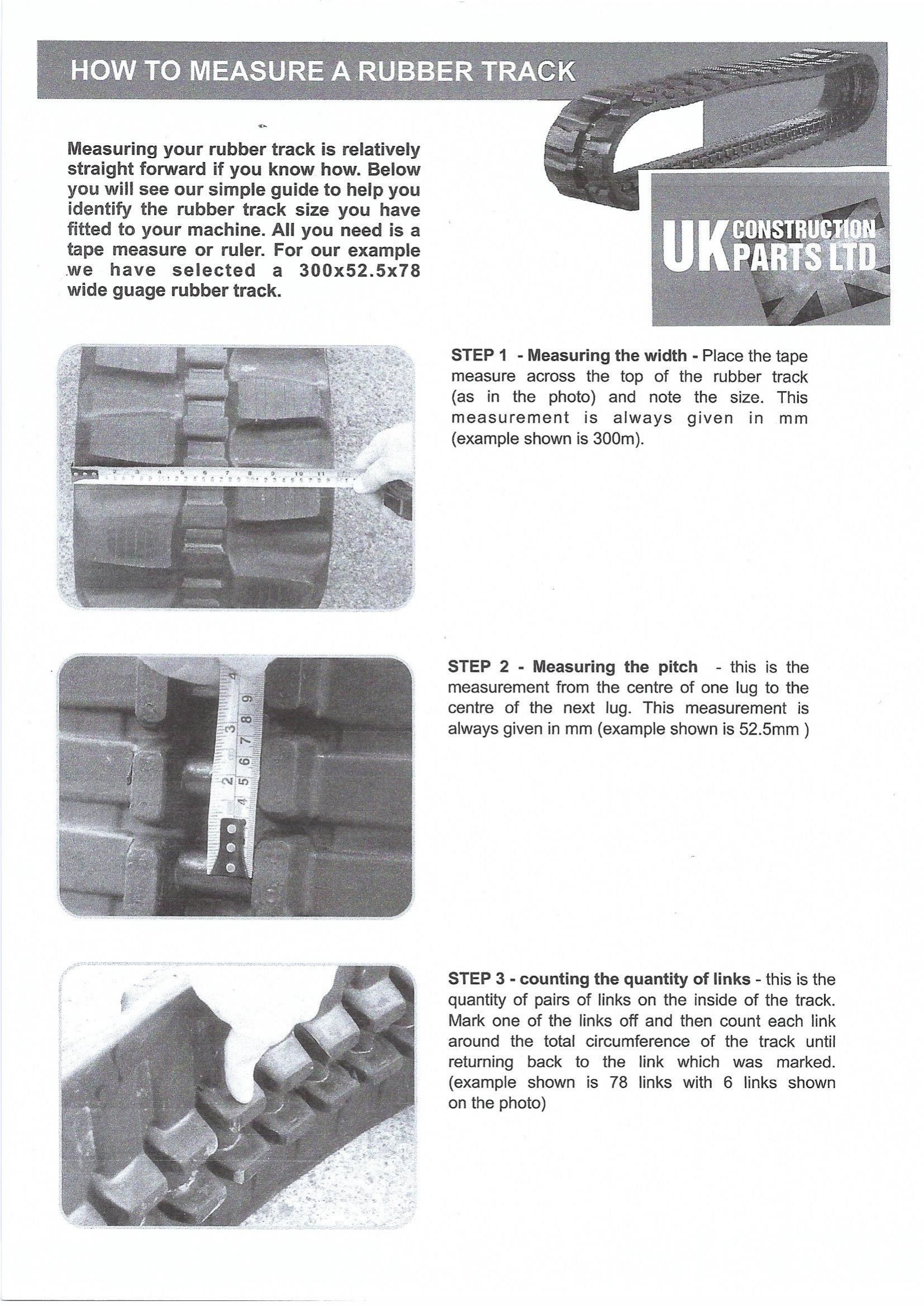
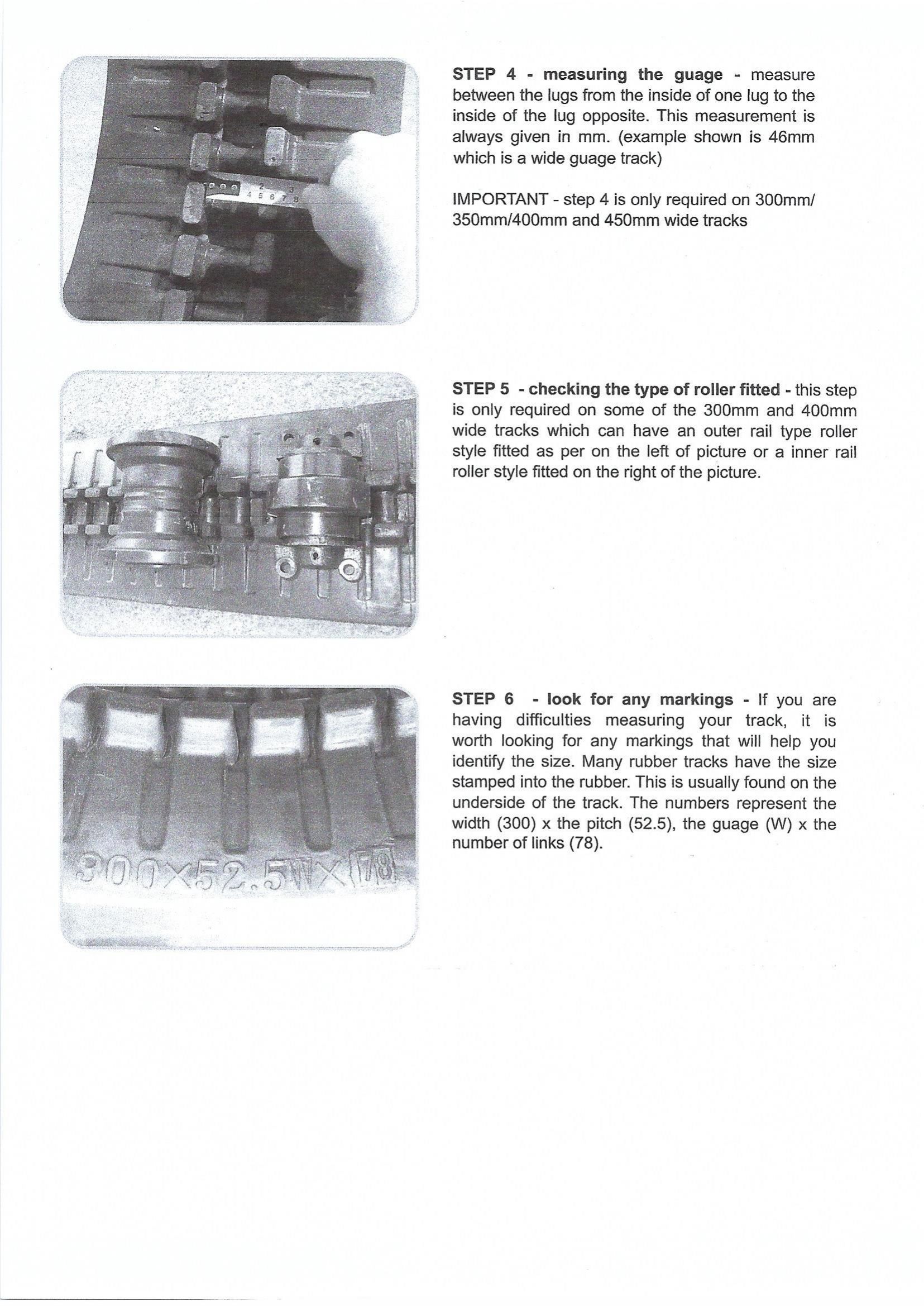
Measuring track width
- Position the track on a flat surface, lugs facing down.
- Measure across the outside (lug side) at the widest point.
- Round to the nearest 10 mm — manufacturer widths are always in round numbers.
Measuring pitch
- Find two adjacent embedded steel links on the inside face of the track.
- Measure from the centre of one link to the centre of the next.
- Take the measurement on a section of track that is laid flat, not curved around an idler or sprocket.
- Take three readings at different points around the track and average them — pitch is more accurate when sampled.
Counting links
- Mark a starting link with chalk or a tie-wrap.
- Count every embedded link as you walk the full circumference of the track.
- End at the marked link. The total is the link count.
- Both tracks on the same machine should have the same link count — if they don't, one has been replaced with a different size in the past.
Where to find the size on your existing track
Many manufacturers mould the size into the inside face of the rubber track. Look for an indented marking like:
230 × 48 × 70300 × 52.5 × 80B400 × 72.5K × 72
The letter prefix or suffix often indicates the tread pattern:
- C — common standard pattern (general construction)
- K — straight-bar (turf-friendly, agricultural)
- W — block-pattern (heavy duty, stable on slopes)
If the moulded marking is worn off, fall back to the three-number physical measurement above.
Common compatible mini-excavators and compact equipment
Rubber tracks at these sizes fit a wide range of UK construction machinery:
- Kubota — KX, U and KX-3/4/5 series mini excavators
- Takeuchi — TB compact excavators
- JCB — 8xxx mini and midi excavators, 1CXT
- Bobcat — E-series mini excavators, T-series compact track loaders
- Caterpillar — 300-series mini, 2xx and 3xx compact track loaders
- Komatsu — PC mini excavators
- Hitachi Construction Machinery — Zaxis ZX mini excavators
- Manitou — MTH compact tracked telehandlers
Steel chains, sprockets and idlers
If your track is wearing prematurely, the cause is often the sprocket or idlers. See our related guides:
Need help sizing or sourcing a rubber track?
Send us a photo of the moulded marking on the inside face plus your machine make, model and serial number, and we will identify the correct track. We supply rubber tracks for all major mini-excavator and compact track loader brands.
Contact us for a quote, or call 01255 323202 to speak to one of our parts team.