
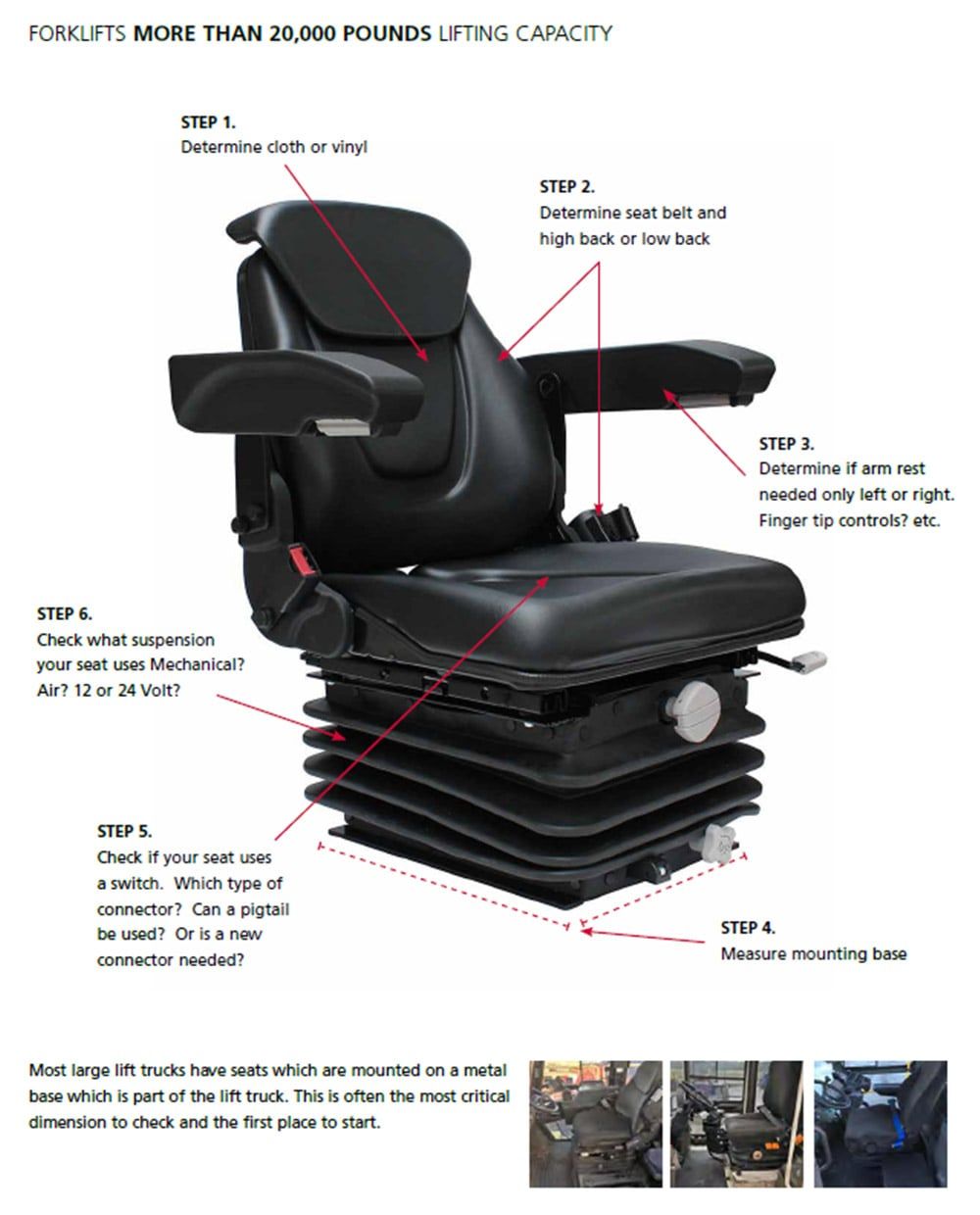
This seat-fitment guide highlights the checks buyers usually miss first time: back style, armrests, seat switch, suspension type and mounting base dimensions.
Getting the right seat for the job: what you need to know
Choosing an operator seat is not just a comfort job. The wrong seat can leave the driver sitting too high, too low, badly supported or fighting vibration all day. On tractors, telehandlers, forklifts, loaders and other off-highway machines, the right replacement seat needs to match the machine, the mounting, the operator and the work.
Static, mechanical suspension or air seat?
The first question is what type of seat the machine actually needs.
Static seat
A static seat has no suspension unit under the cushion base. It suits lighter-duty machines, shorter shifts and compact cabs where space is limited.
A static seat is usually enough when:
- the machine is used for short periods
- the original seat was non-suspension from factory
- ground conditions are relatively smooth
- simplicity matters more than ride comfort
Mechanical suspension seat
A mechanical suspension seat uses springs and dampers to take shock out of the ride. This is often the practical middle ground for tractors, telehandlers, loaders and older construction machines.
A mechanical seat usually makes sense when:
- the operator is in the seat for several hours a day
- the machine works on rough yards, fields or site ground
- there is no air supply for an air seat
- you want better comfort without extra pneumatic complexity
Air suspension seat
An air seat gives finer adjustment and usually better ride quality over long shifts. It is common on higher-spec tractors, telehandlers, sprayers and premium plant.
An air seat is worth the extra complexity when:
- the machine is used all day
- different operators of different weights share the machine
- vibration exposure is a real issue
- comfort and adjustment matter more than lowest cost
If an air seat keeps deflating or will not hold height, the fault may be in the air bag, valve, compressor or pipework rather than the upper cushion section.
Fixed or swivel seat?
A fixed seat is simpler and easier to match to the original mounting. It is still the default on many tractors, forklifts and mowers.
A swivel seat helps on machines where the operator regularly looks sideways or rearward, such as some telehandlers, loaders and municipal machines. The trade-off is added height, extra mechanism wear and less clearance in a tight cab.
High-back or low-back?
A high-back seat generally gives better support for long shifts and rougher applications. It is the better choice where the operator stays seated for long periods.
A low-back seat can suit compact machines where space is tight and getting on and off the machine quickly matters.
As a rule:
- choose high-back for longer hours and rougher work
- choose low-back where compact size and access matter more
Which seat suits which machine?
Tractor seat
A tractor seat usually needs to cope with long hours, repeated field vibration and multiple drivers. Mechanical and air suspension are both common, depending on spec and workload.
Telehandler seat
A telehandler seat often benefits from suspension, strong side support and hard-wearing trim. If the operator is constantly twisting to watch fork position or rear visibility, a swivel base may be useful.
Forklift seat
Forklift seats are often compact and more sensitive to overall height, slide rail spacing, seat switch fitment and belt arrangement. A bulky replacement that technically bolts on can still be the wrong seat.
Excavator or loader seat
Excavators and loaders expose the operator to repeated shock and whole-body vibration. Back support, suspension travel and a secure seating position matter more than cosmetic features.
Sweeper or sprayer seat
These machines can involve long seated hours with steady vibration. Reliable adjustment, breathable trim and decent lower-back support matter.
Ride-on mower seat
Ride-on mower seats are usually simpler, smaller and more exposed to weather. Compact dimensions, drainage and wipe-clean trim may matter more than luxury features.
Operator weight, hours and vibration
The same seat will not suit every operator equally well.
A light operator on an over-stiff suspension seat may get almost no useful movement from it. A heavy operator on an under-rated seat may bottom it out constantly. Before ordering, check:
- the seat's operator weight range
- how the weight adjustment works
- expected hours of use per day
- whether the machine is used on rough ground or hard standing
- how much suspension travel the seat provides
When buyers talk about comfort, the real issue is often vibration exposure. For seated operators, the relevant concern is whole-body vibration rather than hand-arm vibration. Seat choice will not solve every vibration problem, but the right suspension type and travel can reduce what reaches the driver.
For earthmoving machines, EN ISO 7096 is the standard commonly referenced for operator-seat vibration performance. On agricultural tractors, driver seat arrangements are commonly associated with 78/764/EEC. These matter because seat performance is part of machine safety and operator protection, not just comfort.
What must match before you order?
This is where many seat replacements go wrong.
Slide rails and mounting points
Do not assume a replacement "tractor seat" or "telehandler seat" is universal. Measure:
- side-to-side bolt centres
- front-to-rear bolt centres
- whether the base is flat or stepped
- whether rails are supplied or need to be reused
- overall installed height
If the new seat sits too high, the driver can lose headroom and end up with the wrong pedal, steering wheel or joystick position.
Seat belt arrangement
Check whether the machine uses an integrated seat belt mount or whether the belt mounts elsewhere on the cab or frame. Do not assume those setups are interchangeable.
Seat occupancy switch
Many forklifts, tractors and modern off-highway machines use a seat switch for start logic, travel interlocks or PTO safety. If the original seat has a seat occupancy switch, the replacement must suit that system properly.
Heated seat, armrests and headrest: worth it?
Sometimes yes, sometimes no.
Heated seat
Worth having on tractors, telehandlers and other enclosed cabs used through winter. Much less important on basic or seasonal equipment.
Armrests
Useful on long-hour machines, especially where the operator is working joysticks or repetitive controls. On narrow cabs they can just get in the way.
Headrest
More common on high-back seats and longer-shift applications. Check cab clearance before upgrading.
PVC, fabric or cloth trim?
Trim should suit the environment.
PVC or vinyl-style trim is usually better where the cab gets muddy, wet or heavily used. It wipes down easily and stands up well on plant, forklifts and utility machines.
Cloth or fabric trim is often more comfortable over long periods, but it is harder to keep clean in dirty environments.
In simple terms:
- choose PVC where easy cleaning and durability matter most
- choose cloth where long-hour comfort matters more and the cab stays relatively clean
Common seat brands buyers recognise
Buyers often search for recognised seat brands as well as machine type. Common names in the off-highway seat market include Grammer, KAB, Cobo, Sears and United Seats.
That is useful for familiarity, but it should not override fitment. The correct mounting pattern, suspension type, weight range, switch arrangement and overall dimensions matter more than a brand name alone.
Replace the seat or reupholster it?
Not every worn seat needs full replacement.
Reupholstery can make sense when:
- the frame is sound
- the suspension unit still works properly
- the main problem is split trim or worn foam
- the rails and adjustment mechanisms are still serviceable
Replacement is usually the better option when:
- the suspension is worn out
- the frame is cracked or loose
- the seat switch is unreliable
- the rails or locking mechanism are badly worn
- the foam has collapsed badly
- several parts are worn at once
A newly trimmed top section does not fix a tired suspension base.
Tractor seat won't lock, slide or adjust properly
That sort of fault often points to worn runners, bent rails, damaged locking teeth or a failed adjustment mechanism. If the base and frame are otherwise sound, repair can still make sense. If the seat has multiple faults, replacement is usually quicker and cleaner than rebuilding a worn assembly piece by piece.
Final checks before buying a replacement seat
Before ordering, confirm:
- machine make and model
- original seat type: static, mechanical or air
- fixed or swivel base
- high-back or low-back requirement
- operator weight range
- expected hours of use
- mounting bolt centres and rail spacing
- overall seat height and cab clearance
- seat belt arrangement
- seat occupancy switch requirement
- trim type: PVC or cloth
- whether heating, armrests or a headrest are actually wanted
Getting those basics right is what stops a replacement seat turning into a fabrication job or a return.